How to Reduce Time-to-Hire Without Sacrificing Quality
Balance hiring efficiency with quality candidates. Explore techniques to reduce time-to-hire without compromising the caliber of your recruits in 2025.

How to Reduce Time-to-Hire Without Sacrificing Quality
Your biggest priority is filling an engineering role. You know that rushing leads to hiring mistakes, yet waiting too long costs productivity.
A qualified candidate enters your pipeline, but your screening process takes three weeks just to schedule interviews. By the time you are ready to move forward, they have accepted another offer. You are back to square one, extending timelines again.
This dilemma plagues hiring teams constantly.
The real question is not speed versus quality, but how to achieve both at the same time.
“Speed and quality are not opposites. They are outcomes of process design.”
Most organizations underestimate what slow hiring truly costs.
Key realities shaping modern hiring:
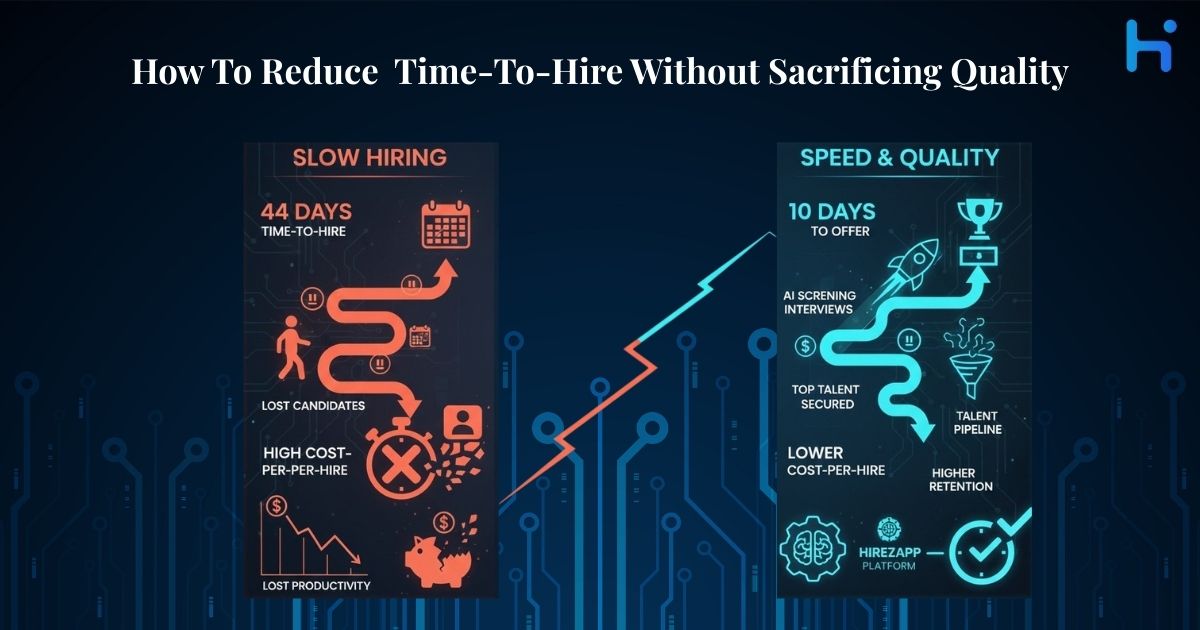
- The global average time-to-hire is now 44 days, up from 31 days in 2023
- 60% of companies reported longer hiring timelines in 2024
- Top candidates stay available for only 10 days before accepting offers
When hiring stretches beyond that window, exceptional candidates are lost before engagement even begins.
The financial impact compounds quickly:
Average cost-per-hire is $4,700
- Extended vacancies cost roughly $35 per hour per role
- A one-month vacancy for a $50,000 role equals $4,500 in lost productivity
- 89% of top talent accepted competing offers because others moved faster
Slow hiring is not just inefficient.It is a competitive disadvantage.
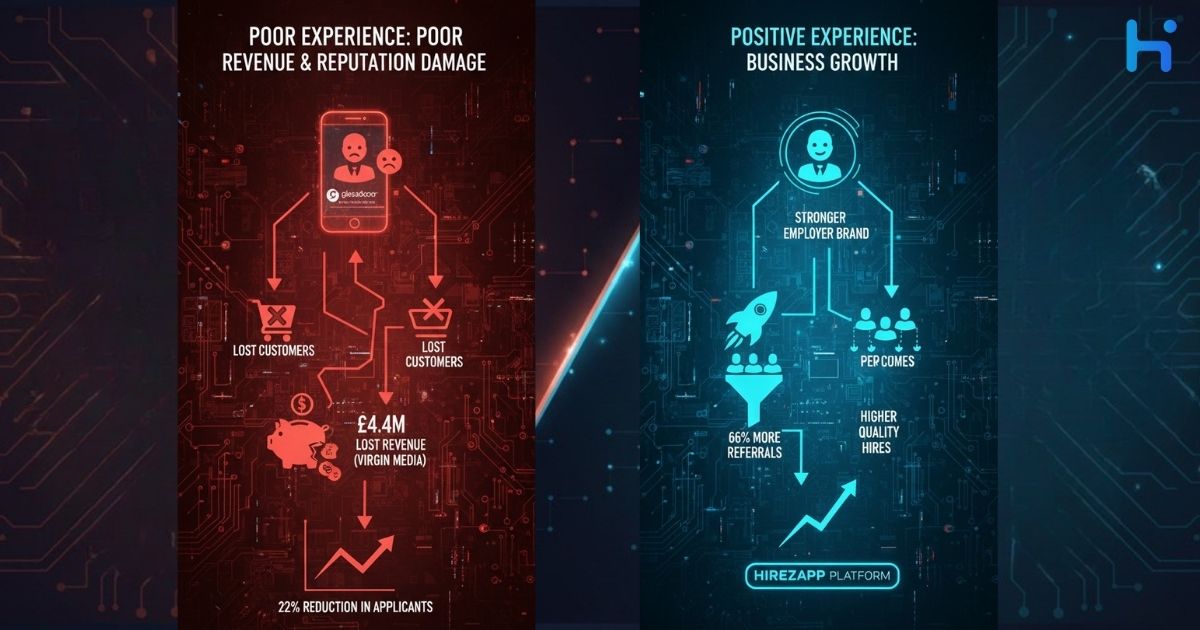
Beyond cost, slow processes damage candidate experience. Long response times signal disinterest, regardless of internal constraints. These perceptions become public through reviews and peer networks, directly affecting employer brand.
Why Quality Cannot Be Ignored
While speed matters, rushing creates its own set of failures.
The cost of poor quality hiring:
- Bad hires cost 15% to 25% of annual salary
- Team morale and productivity suffer long after the hire
- Poor onboarding fit leads to early attrition and repeat vacancies
89% of talent leaders say quality of hire is critical.Yet only 25% feel confident measuring it.
This gap makes speed and quality feel like trade-offs when they do not have to be.
“Fast hiring without rigor is risky. Slow hiring without structure is ineffective.”
Strategy 1: Build and Maintain Strong Talent Pipelines
The fastest way to hire well is to stop starting from zero.
Organizations with strong pipelines fill roles 40% faster because candidates are already vetted and engaged.
Effective pipeline practices include:
- Nurturing high-potential candidates in your ATS
- Maintaining employee referral programs
- Creating role-based talent communities
- Engaging passive candidates before roles open
Employee referrals highlight the impact clearly:
- 55% faster hiring
- Around $3,000 savings per hire
- Better retention and performance
Speed improves because quality already exists in the pipeline.
Strategy 2: Implement Structured Hiring Processes
Structure accelerates decisions while improving accuracy.
Research shows that one structured interview predicts performance as effectively as three to four unstructured interviews.
Structured hiring enables:
- Faster comparisons between candidates
- Objective scoring using defined rubrics
- Fewer interview rounds
- Reduced bias and inconsistency
Companies using structured interviews report up to 40% reduction in hiring timelines.
Structure does not slow hiring.It removes ambiguity.
Strategy 3: Leverage AI and Automation Strategically
AI speeds hiring when used to eliminate friction, not judgment.
What AI does best:
- Resume screening up to 75% faster
- Automated interview scheduling
- Candidate matching at scale
- Instant responses via chatbots
Organizations using AI report:
- 50% reduction in time-to-hire
- 30% reduction in cost-per-hire
- 40% increase in hiring accuracy
The rule is simple:
Automate tasks. Humanize decisions.
Strategy 4: Use Pre-Assessments to Improve Speed and Accuracy
Pre-employment assessments reduce wasted interviews and speed up decisions.
Effective assessments:
- Skills tests for technical roles
- Writing samples for content roles
- Portfolios for design roles
Short, well-designed assessments of 15 to 30 minutes provide clarity early and improve candidate trust when expectations are transparent.
Companies using multiple assessment methods report 92% satisfaction with hires.
Strategy 5: Establish Clear Decision-Making Frameworks
Hiring slows when ownership is unclear.
To eliminate delays:
- Define who makes final decisions
- Limit unnecessary stakeholders
- Set deadlines for every stage
- Use structured scorecards
More opinions do not equal better decisions.Clear authority does.
The Balancing Act: Speed Plus Quality
Speed and quality are not competing goals.They are the result of intentional design.
Hilton reduced time-to-fill by 90% while improving hiring rates by 40% by redesigning their process, not by rushing.
Organizations moving from unstructured to structured interviews reduced timelines by 40% while improving hire quality.
Same rigor.Less friction.Better outcomes.
Measuring Success
Track both dimensions consistently.
Speed metrics:
- Time-to-hire
- Stage-level delays
Quality metrics:
- First-year retention
- 90-day performance
- Manager satisfaction
- Candidate satisfaction
If speed improves but retention drops, the process failed.True success means both metrics improve together.
Your Competitive Edge
Organizations that master speed and quality:
- Fill roles faster
- Attract stronger talent
- Reduce hiring costs
- Build positive employer brands
The future belongs to companies that design hiring intentionally.
Ready to transform your recruitment process?
HireZapp’s AI-powered platform combines structured interviews, automated screening, and intelligent scheduling to help teams hire faster while improving quality of hire. Our clients report 60% reduction in time-to-hire with stronger candidate outcomes through smarter process design.
Frequently Asked Questions
1. Is it possible to reduce time-to-hire without sacrificing quality?
Yes. Companies using structured interviews, AI screening, and assessments reduce time-to-hire by 40 to 50% while maintaining or improving quality.
2. What is the current average time-to-hire?
The global average is 44 days, though top candidates are typically available for only 10 days, making speed critical.
3. Why do both time-to-hire and quality matter?
Fast hiring with poor quality increases turnover. High quality with slow speed loses talent. The goal is simultaneous improvement.
4. How does AI help reduce hiring time?
AI automates resume screening, scheduling, and candidate matching, freeing recruiters to focus on relationship-building and evaluation.
5. Why are structured interviews effective?
One structured interview provides the same predictive value as multiple unstructured interviews, reducing time and bias.
6. How do talent pipelines improve hiring speed?
Pipelines provide pre-screened candidates, enabling 40% faster hiring and better quality through existing relationships.
7. Does automation compromise hiring quality?
No, when used strategically. Automation removes repetitive tasks while humans handle critical judgment.
8. What metrics ensure balance between speed and quality?
Track time-to-hire, retention, performance ratings, manager satisfaction, and candidate experience together.