The Cost of Poor Candidate Experience: Hidden Business Damage
Discover the true cost of poor candidate experience on employer brand, revenue, and hiring. Learn how to fix candidate experience problems and improve outcomes.
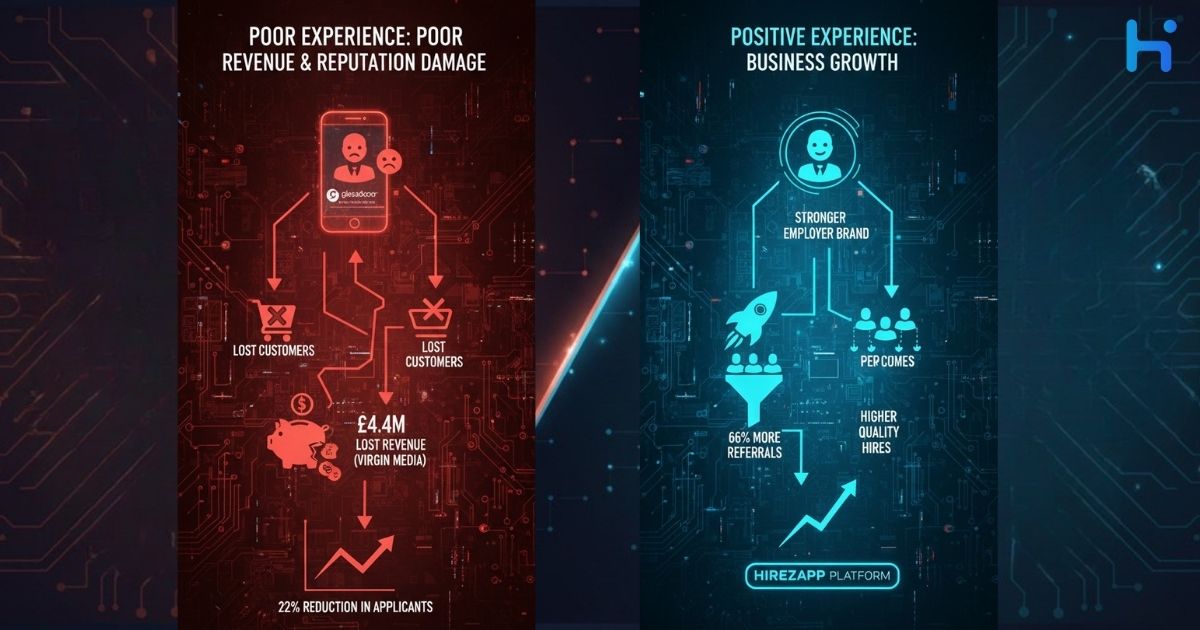

A qualified candidate applies to your job posting.Weeks pass. No response.
When you finally reply, it is a rejection. No feedback. No explanation.
Frustrated, the candidate posts on Glassdoor describing your disorganized, unresponsive hiring process.Thousands read it.
Three potential applicants quietly withdraw.One of them is also a potential customer who now avoids your brand entirely.
This is not a hiring problem. This is a business problem.
A single poor candidate experience can trigger a cascade of damage across employer brand, revenue, and competitive positioning. Yet many organizations remain unaware of how deeply candidate experience impacts business outcomes.
The Ripple Effect: When Candidate Experience Becomes a Business Problem
Most hiring teams underestimate how far poor candidate experience travels.
When candidates experience:
- Ghosting
- Disorganization
- Lack of feedback
- Unclear communication
They do not simply move on.
They talk.
72% of candidates share negative hiring experiences publicly on social media, Glassdoor, Indeed, or within their networks.
This damages the employer brand in ways that take years to recover.
The financial impact is real:
- 72% of job seekers check Glassdoor before applying
- 55% actively avoid companies with poor reviews
- Virgin Media documented a £4.4 million revenue loss tied directly to poor candidate experience
And it goes further.
42% of candidates stop purchasing from companies after a poor hiring experience34% actively discourage others from buying
“Your hiring process is silently influencing customer behaviour.”
The Referral Loss Nobody Measures
Candidate experience directly affects referrals.
- Candidates with positive experiences are 66% to 79% more likely to refer others
- Candidates with negative experiences actively avoid referrals
- Referrals account for 20% to 40% of hires
One poor experience removes not one candidate, but an entire referral network.
This creates a self-reinforcing talent shortage that weakens long-term competitiveness.
Beyond public reputation, poor candidate experience creates invisible financial drains.
- 72% of candidates never receive application responses
- 14% of professionals say they will never engage with the company again
- This rises to 18% for senior and leadership candidates
This leads to:
- Higher hiring difficulty
- Lower applicant quality
- Increased bad hires
The cost of a bad hire ranges from $25,000 to $50,000, and organizations with weak hiring processes make significantly more of them.
Multiply this across teams, roles, and years and the damage compounds quickly.
Ghosting: A Direct Financial Drain
Candidate ghosting is not just frustrating. It is expensive.
- 22% of candidates ghost after accepting offers
- Average cost-per-hire: $4,700
- Estimated cost per 100 hires: $103,400 annually
- Annual productivity loss due to ghosting: $2.5 billion
“Silence has a measurable price.”
How Employer Brand Damage Becomes a Recruitment Crisis
Poor candidate experience weakens employer brand.Weak employer brand makes recruiting harder.
This triggers a cycle:
- Fewer quality applicants
- Longer time-to-hire
- Lower quality hires
- Higher turnover
- Poor team performance
- Negative employee word-of-mouth
According to SHRM, organizations with poor hiring processes are 5 times more likely to make bad hires.
At this point, recruiting becomes reactive and fragile.
How to Stop the Damage
1. Respond Promptly and Consistently
- Send immediate application acknowledgements
- Share realistic timelines
- Communicate at every stage
- Provide thoughtful rejections with feedback
Candidates who feel informed feel respected, even when rejected.
2. Streamline the Application Process
- Reduce unnecessary fields
- Accept LinkedIn profiles
- Make applications mobile-friendly
Simpler applications:
- Increase completion rates
- Improve candidate quality
- Strengthen employer perception
3. Provide Real Feedback
Rejection without feedback feels dismissive.
Providing feedback:
- Preserves goodwill
- Encourages reapplications
- Builds long-term candidate relationships
“Rejection can still be a positive experience.”
4. Standardize and Make Hiring Transparent
- Define clear timelines
- Set decision criteria
- Document processes
- Share expectations with candidates
Transparency removes confusion and builds trust.
5. Make Candidate Experience a Priority
- Train hiring teams
- Set communication standards
- Measure candidate experience
- Hold teams accountable
Organizations that prioritize candidate experience hire better, faster, and more sustainably.
The Path Forward
Poor candidate experience does not stay contained within HR.
It affects:
- Brand reputation
- Revenue
- Customer perception
- Talent pipelines
- Long-term competitiveness
The choice is simple:
Invest proactively in candidate experienceorPay exponentially higher costs later
Most organizations see measurable improvement within months when they act intentionally.
HireZapp helps ensure:
- No candidate is ghosted
- Feedback is consistent
- Communication is automated but human
- Hiring teams stay aligned
Transform candidate experience from a liability into a competitive advantage.
Frequently Asked Questions (FAQs)
1. What exactly is considered poor candidate experience?
Poor candidate experience includes:
- Lack of communication or ghosting
- Overly complex or lengthy applications
- Long hiring timelines with no updates
- Interviews without feedback
- Rejections with no explanation
- Disorganized or unclear processes
Any interaction that leaves candidates feeling disrespected, confused, or undervalued qualifies as poor candidate experience.
2. How does poor candidate experience damage employer brand?
Poor candidate experience damages employer brand through:
- Public reviews on Glassdoor, Indeed, LinkedIn, and social media
- Negative word-of-mouth within professional networks
Key impact:
- 72% of job seekers check reviews before applying
- 55% avoid companies with poor ratings
Once damaged, employer trust takes years to rebuild.
3. Can poor candidate experience really impact company revenue?
Yes, directly.
Research shows:
- 42% of candidates stop purchasing from companies after a poor hiring experience
- 34% actively discourage others from purchasing
Virgin Media documented losing £4.4 million in revenue due to negative candidate experiences.
“Hiring experience doesn’t stop at recruitment. It follows customers into buying decisions.”
4. What does candidate ghosting cost organizations financially?
Candidate ghosting is extremely costly.
- 22% of candidates ghost after accepting offers
- Average cost-per-hire: $4,700
- Estimated annual loss: $103,400 per 100 hires
- Productivity loss from ghosting: $2.5 billion annually
Ghosting wastes recruitment spend, time, and operational capacity.
5. How does poor candidate experience lead to bad hires?
Poor candidate experience usually reflects:
- Weak screening
- Inconsistent evaluation
- Rushed hiring decisions
Organizations with poor hiring processes are:
- 5x more likely to make bad hires (SHRM)
Bad hires cost $25,000 to $50,000 per role and negatively impact team performance and culture.
6. What is the connection between candidate experience and referrals?
Candidate experience directly affects referrals.
- Positive experience: 66–79% more likely to refer others
- Negative experience: candidates actively avoid referrals
Since 20–40% of hires come from referrals, poor candidate experience quietly destroys future hiring pipelines.
7. How long does it take to recover from a damaged employer brand?
Recovery takes time and consistency.
- Initial improvements: 6–12 months
- Full recovery: multiple years
It requires:
- Process improvements
- Hiring team training
- Accumulation of positive candidate experiences
Employer brand recovery is slow, but preventable.
8. What is the fastest way to improve candidate experience?
The quickest win is responsive communication.
- Acknowledge applications
- Share timelines
- Provide updates
- Offer feedback on rejections
This requires minimal investment but creates immediate improvements in candidate perception and satisfaction.
“Respect, clarity, and response speed change everything.”