How to Build Role-Specific Assessments That Actually Predict Performance
You found the perfect resume. The interview went great. But three months later, your new hire is struggling. It’s a frustrating and costly problem that generic screening can’t solve. Relying on resumes alone often leads to mis-hires, slowing down your growth and draining your budget.

Beyond Resumes: A Guide to Building Role-Specific Assessments That Work
You found the perfect resume. The interview went great. But three months later, your new hire is struggling. It’s a frustrating and costly problem that generic screening can’t solve. Relying on resumes alone often leads to mis-hires, slowing down your growth and draining your budget.
The key isn't just to screen candidates, but to predict their on-the-job success. This guide will show you how to build simple, effective role-specific assessments that help you identify top performers before you make an offer.
Why Your Current Hiring Process Feels Like a Gamble
If your hiring feels more like luck than a repeatable system, you're not alone. Many teams struggle with the same hidden issues that lead to bad hires. The problem isn't the candidates; it's often a process that isn't built to find the right signals.
Recruiter reality: “We get hundreds of applicants who look good on paper, but we have no reliable way to tell who can actually do the job. It feels like we're just guessing and hoping for the best.”
Here’s what might be causing the disconnect:
- Generic Tests
Using the same off-the-shelf quiz for a marketer and an engineer doesn't tell you anything useful about either. - Overlooking Soft Skills
A brilliant coder who can't collaborate or take feedback can disrupt an entire team. Resumes rarely reveal these traits. - No Link to Daily Tasks
Your assessment doesn't mirror the actual challenges the person will face in their first 90 days. - Unconscious Bias
Questions or scenarios may unintentionally favor one background or communication style over another. - No Clear Scoring
Without a rubric, evaluating assessments becomes subjective, and you end up back at 'gut feel' decisions.
A Step-by-Step Framework for Role-Specific Assessments
Building an effective assessment isn't about creating a complex, academic exam. It’s about creating a clear connection between the test and the job itself. Following these assessment design best practices will give you a clear, repeatable path to better hiring decisions.
- Define Job Outcomes First
Before listing skills, ask: “What must this person accomplish in their first six months?” This shifts your focus from a list of qualifications to actual performance goals. - Identify Core Competencies
Based on the outcomes, list the 3-5 essential hard and soft skills required. For a sales role, this might be 'product knowledge' and 'objection handling'. - Choose the Right Assessment Type
Select a format that matches the work. A work sample task is great for creators, while a situational judgment test works well for managers. - Design a Realistic Scenario
Create a short, practical task that mirrors a real problem the candidate would solve. Avoid abstract or trick questions. - Build a Simple Scoring Rubric
Define what 'bad,' 'good,' and 'great' look like for the assessment. This makes evaluation fair and consistent across all candidates. - Test It Internally
Have a current team member take the assessment to check for clarity and timing. Their feedback helps you refine it before it goes live. - Administer and Track Consistently
Give every shortlisted candidate the same assessment under the same conditions to ensure a level playing field. - Review for Predictive Power
After a few months, compare your new hires' performance against their assessment scores to ensure your process maintains pre-employment testing validity.
Templates You Can Use Today
You don't need to start from scratch. Here is a simple assessment scorecard template you can adapt for a 'Content Marketing Manager' role. The goal is to move from a simple pass/fail to a more detailed evaluation.
Assessment Scorecard: Content Marketing Manager
- Strategic Thinking
Does the candidate's content brief show an understanding of the audience and business goals? (Score 1-5) - Writing Clarity and Tone
Is the sample blog post clear, engaging, and aligned with our brand voice? (Score 1-5) - Creativity
Did the candidate propose unique or interesting angles for the topic? (Score 1-5) - Attention to Detail
Is the submission free of typos and grammatical errors? (Score 1-5) - SEO Awareness
Did the candidate naturally include keywords and consider search intent? (Score 1-5)
Where HireZapp Fits In
Building and managing this process manually can be overwhelming, especially when you're juggling multiple roles. HireZapp provides the integrated tools to make it fast, fair, and scalable.
- AI Job Description Generator
This feature helps you instantly identify the core competencies and outcomes for any role, giving you a strong foundation for your assessment design. - Customizable Assessments
Build your own role-specific tasks, questions, and work samples directly within the platform. Stop using generic tests that don't predict performance. - Integrated ATS Pipeline
Send assessments, track submissions, and see scores all in one place. No more switching between spreadsheets and email. - Job Match Score
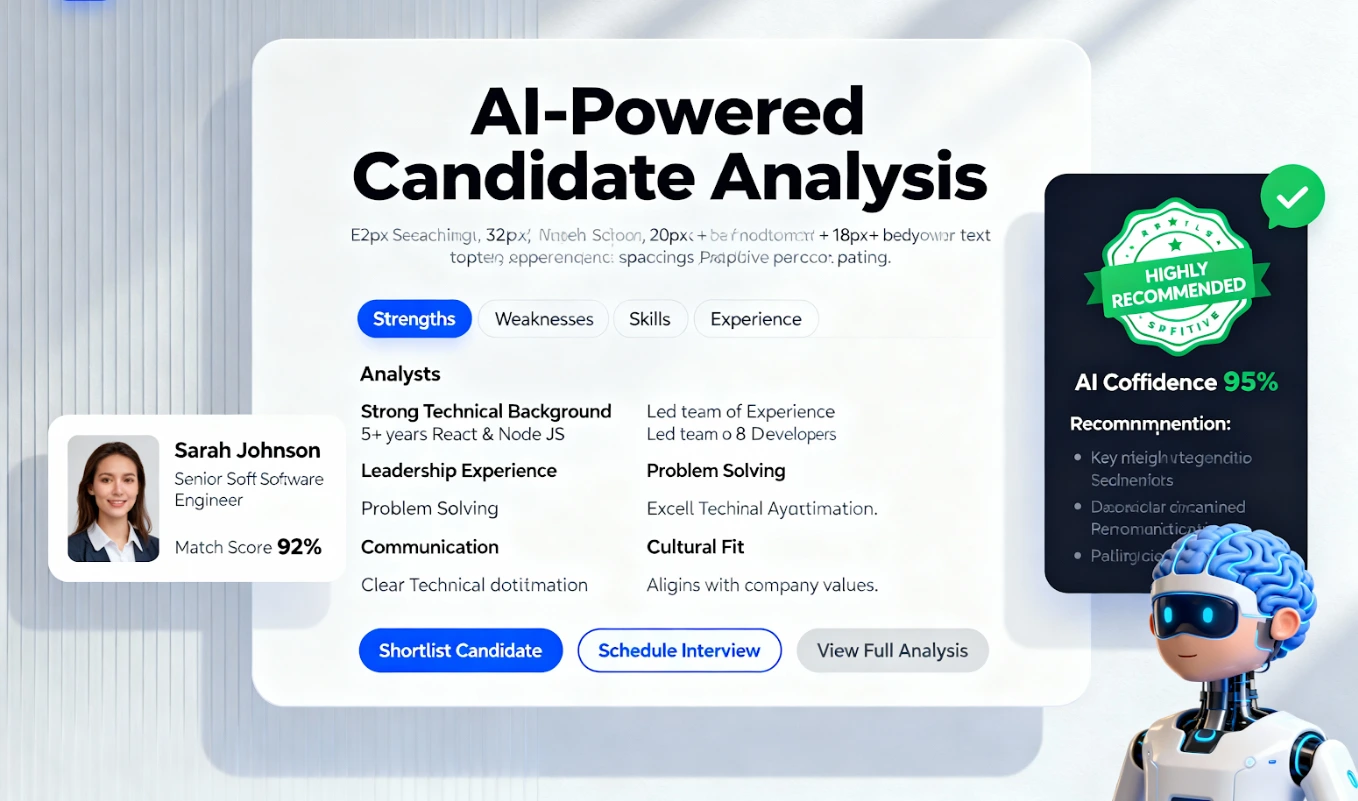
Our system combines assessment results with skills and experience to give you a single, holistic score for every applicant, making shortlisting fast and easy.
Common Mistakes That Keep Teams Stuck
Even with the best intentions, small missteps can undermine your assessment strategy. Watch out for these common mistakes that prevent companies from making great hires.
- Relying only on personality or cognitive tests without a work sample.
- Making the assessment too long, causing top candidates to drop off.
- Forgetting to explain the 'why' behind the assessment to the candidate.
- Changing the scoring criteria from one candidate to the next.
- Ignoring the results if you have a strong 'gut feeling' about a candidate.
- Failing to get feedback from candidates on the assessment experience.
What a Great Assessment Won't Fix
Effective assessments are a powerful tool, but they are not a silver bullet for all hiring challenges. To build a truly great team, you also need to focus on other critical areas. An assessment process can't fix:
- A non-competitive salary or benefits package.
- A negative company culture or poor leadership.
- A confusing or poorly written job description.
- A slow or unresponsive communication process with candidates.
- An unclear vision for the role or the company's direction.
Start Hiring for Performance, Not Just Keywords
Moving beyond resumes and interviews is the single best way to improve hiring quality. By building simple, role-specific assessments, you create a fair and predictable process that identifies people who will truly thrive on your team. It's the most reliable way to turn applicants into high-performing hires.
Predictive Assessments: Hire Better, Faster.
Transform your hiring with AI-powered assessments that accurately predict job performance and reduce mis-hires.
Frequently Asked Questions
1) What are role-specific assessments?
They are pre-employment tests or tasks designed to evaluate the specific skills and competencies required for a particular job, rather than testing general knowledge or personality traits. Examples include coding challenges for developers or a portfolio review for designers.
2) How do you ensure assessments are fair and unbiased?
To ensure fairness, use a structured scoring rubric for all candidates, base the assessment on essential job functions only, and regularly review the questions for any language that could be biased. It is also a good practice to have the assessment reviewed by a diverse group of team members.
3) What's the difference between a skills test and a work sample?
A skills test typically measures a specific, isolated skill, often through multiple-choice questions (e.g., a grammar test). A work sample is a task that requires the candidate to combine multiple skills to complete a task that mirrors the actual job (e.g., writing a short blog post).
4) How long should a pre-employment assessment be?
The ideal length is between 30 and 60 minutes. Anything longer risks a high drop-off rate from qualified candidates who are busy or interviewing with multiple companies. Always be respectful of the candidate's time.
5) Can small companies use predictive hiring assessments?
Absolutely. Small companies benefit greatly from predictive hiring assessments because the cost of a single mis-hire is much higher. Using tools like HireZapp makes it affordable and easy to implement a professional-grade assessment process without a dedicated HR team.
6) How do I measure job performance prediction?
The simplest way is to compare a new hire's performance review scores after 3-6 months with their initial assessment score. Over time, you should see a positive correlation where candidates who scored higher on the assessment also perform better in the role.
7) What are some common candidate assessment methods?
Common candidate assessment methods include work sample tests, situational judgment tests (SJTs), cognitive ability tests, and structured interviews where all candidates are asked the same job-related questions. The best approach often combines two or more of these methods.
8) How can I reduce mis-hires with better testing?
Better testing helps reduce mis-hires by providing objective data on a candidate's ability to perform the core functions of the job. It moves you beyond subjective 'gut feelings' from an interview and focuses on concrete evidence of skills, leading to more reliable hiring decisions.