Candidate Evaluation Matrix: How to Score Consistently
Does this sound familiar? Your team interviews a great candidate. One manager is ready to hire them on the spot, but another is completely against it. Now you are stuck in endless debates, trying to figure out who is right while the candidate accepts another offer.

How to Build a Candidate Evaluation Matrix for Fairer, Faster Hiring
Does this sound familiar? Your team interviews a great candidate. One manager is ready to hire them on the spot, but another is completely against it. Now you are stuck in endless debates, trying to figure out who is right while the candidate accepts another offer.
This kind of confusion slows down hiring and leads to inconsistent results. Moving away from 'gut feelings' and toward a structured system helps you hire the right person for the role, every single time. A simple scoring tool can bring clarity and speed to your process.
What's Really Causing Inconsistent Hiring?
When hiring decisions feel random, it is usually because the process itself is broken. Many growing companies face the same challenges when they scale their teams. The problem often comes down to a few common issues that get in the way of clear, objective decisions.
- Relying on 'gut feel' interviews.
Different interviewers focus on different things, leading to biased and unreliable feedback. - Asking inconsistent questions.
Without a standard set of questions, you cannot compare candidates fairly. - Vague job descriptions.
If the team is not aligned on what 'good' looks like, they cannot evaluate candidates against it. - No central scoring system.
Feedback is scattered across emails, messages, and different documents, making comparisons impossible. - Letting personal bias interfere.
Unconscious bias can cause interviewers to favor candidates who are similar to them, not the best for the job. This is a key reason to reduce hiring bias in your process.
A Step-by-Step Guide to Building Your Matrix
Creating a system for consistent hiring decisions does not have to be complicated. You can build a practical framework in under an hour. Follow these steps to create a process that is fair, repeatable, and effective.
- Define Core Competencies.
Work with the hiring manager to list the top 5-7 'must-have' skills and traits for the role, including both technical and soft skills. - Choose a Simple Scoring Scale.
A 1-5 scale works well. For example: 1 = Does Not Meet, 3 = Meets Expectations, 5 = Exceeds Expectations. - Assign Weights to Each Skill.
Decide which skills are most critical. You might give 'Technical Expertise' a weight of 3x, while 'Team Collaboration' gets a 1x weight. - Create Standard Interview Questions.
Write 2-3 questions for each competency to ensure you are using a structured interviewing approach with every candidate. - Train Your Hiring Team.
Briefly walk everyone through the matrix, the scoring scale, and the questions to ensure everyone is aligned. - Score Candidates Immediately After Interviews.
Have each interviewer fill out the matrix while their memory is fresh, before discussing the candidate with others. - Review Scores and Make a Decision.
Compare the weighted scores to see which candidate is the strongest match based on data, not just feelings.
A Recruitment Scorecard You Can Use Today
You can start with a simple checklist. While we cannot offer a direct download here, you can easily copy the structure below into your own document. This example is for a Sales Development Representative role, but you can adapt it for any position.
Example Scoring Criteria:
- For a Sales Role:
Focus on communication clarity, coachability, prospecting experience, and objection handling. - For an Engineering Role:
Prioritize problem-solving skills, specific language proficiency, system design knowledge, and past project complexity.
Here is a basic recruitment scorecard for a sales role:
- Prospecting Experience (1-5 Score)
- Communication Skills (1-5 Score)
- Coachability (1-5 Score)
- Product Understanding (1-5 Score)
- Objection Handling (1-5 Score)
- Team Collaboration (1-5 Score)
Where HireZapp Fits In
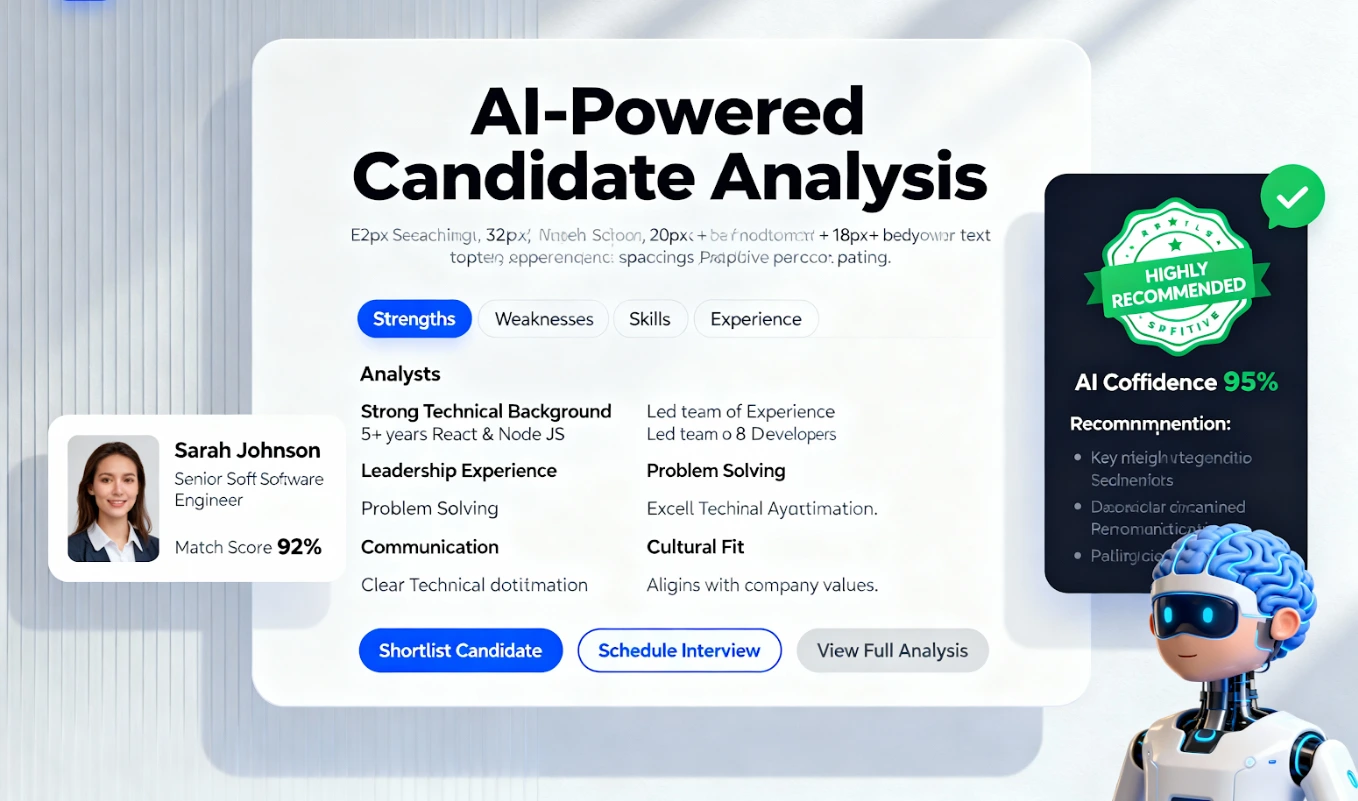
A manual candidate evaluation matrix is a great start. But as you grow, manually tracking scores for dozens of applicants becomes a bottleneck. HireZapp automates the heavy lifting, integrating data-driven scoring directly into your workflow.
Recruiter reality: 'I used to spend hours comparing notes in a spreadsheet. Now, I can see a ranked list of the best candidates in seconds, which lets me focus my time on talking to the right people.'
Here is how HireZapp helps you build a better, faster process:
- AI Job Descriptions and Forms
Automatically generate JDs with key competencies built in, so your evaluation starts from a strong foundation. - Job Match Score
Our AI instantly screens and scores applicants against your job requirements, giving you a prioritized list of top talent. A high job match score means the candidate is a great fit on paper. - Centralized Candidate Pipeline
All candidate information, scores, and feedback are in one place, making it easy for your team to collaborate and review applicants. - Assessments and Automation
Integrate skills tests directly into your workflow and use our automated follow-ups to keep every candidate engaged.
Common Mistakes That Keep Teams Stuck
Implementing an applicant scoring system is a powerful move, but a few common mistakes can undermine its effectiveness. Watch out for these pitfalls that can prevent you from achieving total hiring consistency.
- Making the matrix too complex with dozens of criteria.
- Forgetting to include soft skills like communication or adaptability.
- Failing to train the interview team on how to use the scorecard.
- Allowing one very high or low score to outweigh all other data.
- Not reviewing and updating the matrix based on new hire performance.
- Building the scorecard alone without input from the hiring manager.
What This Won't Fix
A scorecard is a tool, not a magic wand. It improves the evaluation part of your process, but it cannot solve foundational hiring problems. Be aware that a matrix will not fix:
- A poorly defined job role or inaccurate job description.
- A weak talent pipeline with not enough qualified applicants.
- A slow or confusing application process that causes candidates to drop off.
- A negative employer brand or poor company reputation.
- A non-competitive compensation and benefits package.
From Guesswork to Great Hires
Switching from subjective interviews to a data-driven process is the fastest way to improve your hiring outcomes. By using a consistent framework, you can make smarter decisions, reduce bias, and confidently hire the people who will help your company grow. Ready to make your hiring process more predictable? See how HireZapp can help.
Score Consistently. Hire Smarter.
Go beyond matrices. HireZapp's AI automates consistent candidate scoring, eliminates bias, and finds your ideal hires.
Frequently Asked Questions
1) What is a candidate scoring rubric?
A candidate scoring rubric is a tool used to evaluate job applicants against a standard set of criteria. It uses a predefined scale (like 1 to 5) to assign scores for different skills, qualifications, and competencies, ensuring every candidate is judged by the same standards.
2) How does a candidate evaluation matrix reduce hiring bias?
By focusing the evaluation on predefined, job-relevant criteria, the matrix forces interviewers to assess skills rather than relying on 'gut feel' or personal affinity. This structured approach minimizes the impact of unconscious bias related to factors like background, gender, or age.
3) Can I use the same evaluation form for every role?
No, you should customize the criteria for each role. While some core values or soft skills might be consistent across the company, the technical and role-specific skills will be very different for a software engineer versus a marketing manager.
4) What is the difference between a manual scorecard and an automated job match score?
A manual scorecard is filled out by interviewers after a conversation to rate a candidate's skills. An automated job match score, like the one in HireZapp, is an AI-driven calculation that happens before interviews, scoring a candidate's profile against the job description to quickly surface the most qualified applicants.
5) How many criteria should be on our applicant scoring system?
It is best to stick to 5-8 core criteria. Any more than that and the scorecard becomes too complicated and time-consuming for interviewers to use effectively. Focus only on the most critical requirements for success in the role.
6) What is a candidate assessment framework?
A candidate assessment framework is the overall strategy and set of tools a company uses to evaluate candidates. It includes everything from the initial application screening and assessments to the interview questions and the final scoring matrix.
7) How do we get our hiring managers to actually use the new system?
Involve them in creating the matrix from the beginning. When they help define the key criteria and questions, they will have ownership over the process and be much more likely to adopt it. Also, keep it simple and demonstrate how it saves them time.