Job Match Score Explained: A Practical Framework for Evaluating Candidate Fit
Feeling overwhelmed by a flood of applications? Sifting through endless resumes, dealing with candidate drop-offs, and relying on gut feel can slow your hiring to a crawl. You spend hours shortlisting candidates only to find they aren't the right fit in the first interview. This scattered process makes it nearly impossible to compare applicants fairly and move quickly on top talent.
The goal is to bring clarity and speed to your hiring. A structured approach helps you identify the best candidates based on data, not just a feeling. This ensures every minute you spend is on applicants who truly have the potential to succeed in the role, leading to better, faster hires.
Why 'Gut Feel' Hiring Is Holding You Back
Many recruiters and founders notice that unstructured hiring creates consistent problems. Without a clear system, you might be facing challenges that are difficult to pinpoint but have a huge impact on your success. A systematic approach helps reduce hiring bias and strengthens your entire process.
- Inconsistent evaluations where one candidate is judged differently than another.
- Letting unconscious bias influence who moves forward to the interview stage.
- Overlooking critical skills because a resume looks impressive on the surface.
- Struggling to justify hiring decisions to team members or leadership.
- Wasting valuable interview time with candidates who are clearly not a match.
- Losing great applicants because your decision-making process is too slow.
A Step-by-Step Candidate Assessment Framework
Building a simple, repeatable system is the fastest way to improve your hiring outcomes. This framework helps you create objective hiring criteria that you can apply consistently to every single applicant. Follow these steps to build your own process.
- First, break down your job description into core components. List the essential skills, required years of experience, and key character traits needed for success.
- Next, separate your criteria into two groups. Clearly define which are absolute 'must-haves' and which are 'nice-to-haves'.
- Then, assign a weight or importance level to each criterion. Not all skills are created equal, so your most critical requirements should have a bigger impact on the final score.
- Create a simple scoring scale to rate candidates. A basic 1 to 5 scale works perfectly, where 1 is 'does not meet' and 5 is 'exceeds expectations'.
- Apply your scorecard consistently at each stage. Use it while screening resumes, reviewing assessments, and after conducting interviews to maintain fairness.
- Finally, calculate the total score for each candidate. This gives you a clear, data-backed rank of your top applicants, making your final decision much easier.
Your Applicant Scoring Matrix Template
You can create a simple scorecard for any role. Here are two examples to get you started. These templates provide a clear structure for your candidate fit evaluation and ensure you focus on what truly matters.
Example Scorecard: B2B Sales Representative
- Proven experience in B2B SaaS sales (Must-Have)
Rate on a scale of 1-5 based on their resume and interview answers. - History of meeting or exceeding sales quotas (Must-Have)
Rate on a scale of 1-5 based on specific achievements they share. - Familiarity with CRM software like Salesforce (Nice-to-Have)
Rate on a scale of 1-3, as this can be taught. - Clear and persuasive communication skills (Must-Have)
Rate on a scale of 1-5 based on their performance during the interview.
Example Scorecard: Software Engineer
- Proficiency in Python and relevant frameworks (Must-Have)
Rate on a scale of 1-5 based on technical assessment and project history. - Experience with cloud platforms like AWS (Must-Have)
Rate on a scale of 1-5 based on their resume and technical discussion. - Contributions to open-source projects (Nice-to-Have)
Rate on a scale of 1-3 as an indicator of passion and collaboration. - System design and problem-solving ability (Must-Have)
Rate on a scale of 1-5 based on the technical interview or take-home test.
How HireZapp Automates Your Recruitment Scoring System
Manually tracking scores on a spreadsheet works, but it can be slow and prone to errors. An integrated system removes the administrative work so you can focus on connecting with great candidates. HireZapp is designed to make this process seamless.
- AI Job Description Generation
Helps you create clear job posts with well-defined criteria from the start. - Customizable Job Forms
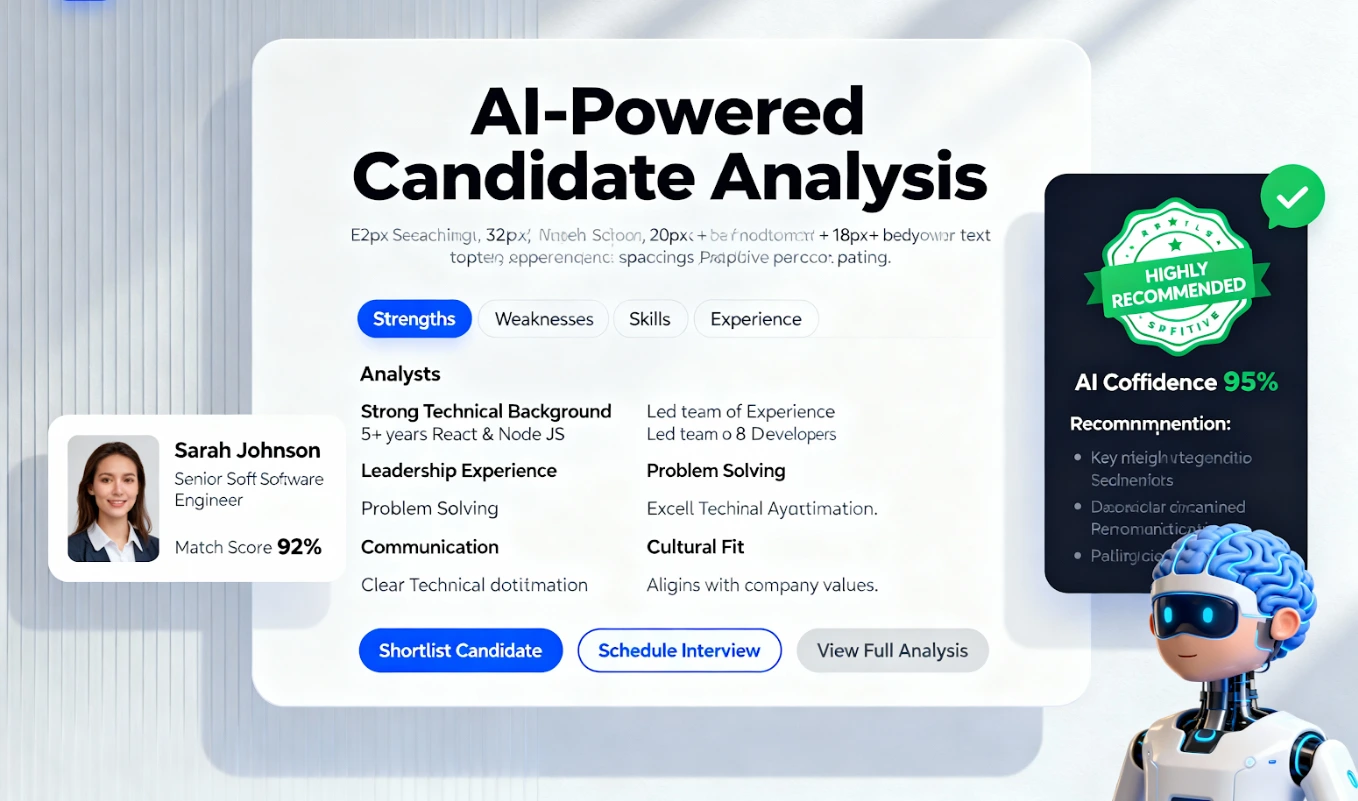
Allows you to ask screening questions that map directly to your scorecard. - Automated Job Match Score
Instantly provides an ATS job match score for every applicant based on your rules. - Centralized ATS Pipeline
Displays a ranked list of candidates, so you always know who to talk to next. - Employer Branding Suite
Ensures your careers page and communications reflect the professionalism of your hiring process.
Recruiter reality: "I used to spend half my day just trying to figure out who to screen first. Now, I open my dashboard and my top 10 candidates are already ranked and waiting for me. It's a game-changer."
Common Traps That Invalidate Your Scorecard
A scoring system is only effective if it's used correctly. Watch out for these common mistakes that can undermine your efforts to create an objective process.
- Making the scorecard too complex with dozens of different criteria.
- Forgetting to include and score for essential soft skills like teamwork or adaptability.
- Allowing personal feelings to override the data-driven score without a good reason.
- Failing to get buy-in from the entire hiring team on using the system.
- Using the same generic scorecard for every role in the company.
- Not reviewing and updating the scorecard as the role's needs change over time.
A Scorecard Is a Tool, Not a Magic Wand
Implementing a Job Match Score is a powerful step, but it is important to have realistic expectations. A scorecard is part of a larger strategy and cannot fix underlying issues on its own. This system will not solve:
- A weak talent pipeline with too few qualified applicants.
- A negative employer brand or a poor candidate experience.
- A disorganized or disrespectful interview process.
- A fundamental disagreement among stakeholders about what the role truly requires.
From Guesswork to Great Hires
Moving away from gut-feel hiring is the single biggest step you can take to improve your recruiting. By implementing a simple, objective scoring system, you create a fair process that helps you identify the best candidates faster. This structured approach builds confidence in your decisions and leads to stronger, more successful hires.
Perfect Candidate Fit, Instantly.
HireZapp's AI-powered Job Match Score automates evaluation, scaling your hiring with precision.
Trusted by 200+ recruiters
|Backed by AWS & NVIDIA
Frequently Asked Questions
1) What is a Job Match Score?
A Job Match Score is a numerical value assigned to a job applicant that represents how well their skills, experience, and qualifications align with the specific requirements of a job description. It is a key part of any modern recruitment scoring system.
2) How does a Job Match Score help reduce hiring bias?
It forces evaluators to assess every candidate using the same pre-defined, objective criteria. This minimizes the influence of unconscious biases related to factors like name, background, or personal connection, leading to a more fair and merit-based selection process.
3) Isn't this just another term for "culture fit"?
No, they are different. A Job Match Score is based on concrete, role-specific criteria like skills and experience. "Culture fit" is often a vague and subjective assessment that can introduce bias. A better approach is to evaluate for "value alignment" as one of several weighted criteria in your scorecard.
4) How many criteria should I include in my scoring system?
It is best to keep it simple. Aim for 5-8 core criteria that are truly essential for success in the role. Including too many can make the scorecard complicated and difficult to use consistently.
5) Can a scoring system be used for all types of roles?
Yes, absolutely. The framework is adaptable to any role, from entry-level to executive. The key is to customize the specific criteria and their weights for each unique position, whether it is in sales, engineering, marketing, or operations.
6) How do I get my hiring managers to actually use this system?
Involve them in the process of creating the scorecard for their roles. When they help define the criteria and weights, they feel a sense of ownership and are much more likely to adopt and trust the system.
7) What is the difference between a manual scorecard and an ATS job match?
A manual scorecard is typically a spreadsheet you have to update by hand for every candidate. An ATS job match, like the one in HireZapp, automates the entire process. It scores candidates instantly as they apply based on your rules, saving significant time and eliminating manual data entry.