Hiring Funnel Metrics: Conversion Rates by Stage
You are spending money on job ads and getting a flood of applications, but the roles stay open. Candidates seem interested, then suddenly go quiet. You are stuck managing a messy spreadsheet or a chaotic inbox, trying to figure out who is qualified and who to talk to next. This isn't a pipeline; it's a leak.

Hiring Funnel Metrics: A Founder's Guide to Conversion Rates
You are spending money on job ads and getting a flood of applications, but the roles stay open. Candidates seem interested, then suddenly go quiet. You are stuck managing a messy spreadsheet or a chaotic inbox, trying to figure out who is qualified and who to talk to next. This isn't a pipeline; it's a leak.
Understanding your hiring funnel metrics is the first step to fixing it. By turning raw application numbers into clear insights, you can build a predictable hiring process that converts the right applicants into hires, faster.
Why Your Hiring Funnel Is Leaking Candidates
If you feel like you are losing great people, it is likely due to a few common, fixable issues. Many recruiters notice these problems crop up when they are trying to scale hiring without a clear system in place.
- Vague job descriptions that attract unqualified or mismatched applicants.
- A long and complicated application process that causes people to give up.
- Slow communication between stages, leaving top talent feeling ignored.
- Inconsistent interview questions that make it hard to compare candidates fairly.
- Manually tracking everything, which leads to mistakes and lost information.
- Not knowing which job boards or sourcing channels deliver the best candidates.
A Step-by-Step Playbook to Optimize Your Hiring Funnel
Transform your hiring process from reactive to strategic with this simple playbook. Following these steps will help you identify exactly where you can make improvements to get better results from the effort you are already putting in.
- Define Your Stages Clearly.
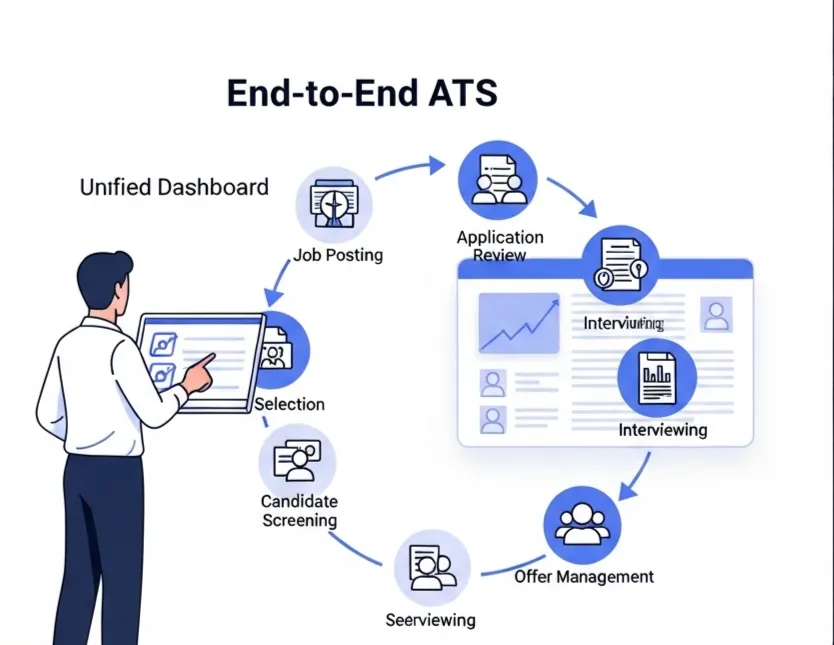
First, map out your process. A common funnel includes: Applied, Screened, Interviewed, Offer, and Hired. - Calculate Application to Screened Rate.
This shows if your job posts attract qualified people. The formula is (Screened Applicants / Total Applicants) * 100. A low rate means the job description may need work. - Measure Screened to Interview Rate.
This tells you how many qualified applicants are making it to a conversation. The formula is (Interviewed Candidates / Screened Applicants) * 100. - Analyze Your Interview to Offer Ratio.
This key metric reveals the effectiveness of your interview process. The formula is (Offers Made / Interviewed Candidates) * 100. If this is low, your team may not be aligned on what a good candidate looks like. - Track Your Offer Acceptance Rate.
This is the final step and shows how competitive your offers are. The formula is (Hires Made / Offers Made) * 100. A low offer acceptance rate can signal issues with salary, benefits, or company culture. - Identify and Address Drop-Off Points.
Look at the conversion rate between each stage. A big drop is a red flag. High candidate drop-off rates between applying and screening often point to a poor application experience. - Review and Repeat.
Consistently track these numbers. This allows you to see if your changes are actually improving the funnel over time.
Templates You Can Use Today
Data is only useful when you act on it. Use these simple templates to bring more structure and consistency to your hiring process, helping improve your metrics at key stages.
Candidate Follow-Up Message
Use this template for a quick update after an interview to keep candidates engaged.
Hi [Candidate Name],
Thanks again for speaking with us about the [Role Title] position. The team was impressed with your background. We are finalizing next steps and will have an update for you by [Date/Day].
Best,
[Your Name]
Interview Scorecard Checklist
Use a simple checklist to make sure every interviewer is evaluating candidates on the same core criteria. This improves your interview to offer ratio by making decisions more objective.
- Relevant technical skills demonstrated
- Clear and effective communication
- Problem-solving approach aligns with our team
- Shows genuine interest in the company mission
- Asks thoughtful questions about the role
- Salary expectations are within range
- Cultural fit and alignment with team values
How HireZapp Strengthens Your Funnel
Tracking metrics manually is time-consuming and prone to errors. HireZapp automates the data collection so you can focus on making smart decisions, not managing spreadsheets. Our goal is to help you optimize your hiring funnel without the busywork.
- AI-Powered Job Descriptions
Generate clear, effective job posts that attract qualified candidates from the start. - Job Match Score
Automatically surfaces the most relevant applicants, improving your Application to Screened rate instantly. - Automated ATS Pipeline
Tracks every candidate's movement between stages, giving you real-time data on your recruitment conversion rates. - Branded Candidate Communications
Sends automated, professional follow-ups to keep every applicant engaged and informed.
Common Mistakes That Keep Teams Stuck
Knowing the metrics is the first step, but avoiding common pitfalls is what truly moves the needle. Watch out for these habits that can stall your hiring progress.
- Focusing only on the final number of hires instead of the entire funnel.
- Ignoring the candidate experience in favor of internal processes.
- Using a one-size-fits-all hiring process for every single role.
- Failing to communicate with candidates who are not selected.
- Relying completely on "gut feel" during interviews without structured feedback.
- Not having a clear, shared definition of what a "qualified" candidate is.
What Metrics Alone Will Not Fix
Data provides incredible clarity, but it is not a magic wand. Tracking your funnel is crucial, but remember that it cannot solve foundational business issues.
- A weak or unknown employer brand.
- A non-competitive salary and benefits package.
- A poor company culture that current employees talk about.
- An unstructured interview process with unprepared interviewers.
From Leaky Funnel to Hiring Machine
Stop guessing where your best candidates are disappearing. By systematically tracking your hiring funnel, you move from feeling overwhelmed to being in control. This data-driven approach helps you build a predictable process that consistently brings in the right people and turns them into your next great hires.
Master Your Hiring Funnel Metrics?
Stop guessing! HireZapp’s AI-ATS optimizes your funnel, automates screening, and boosts conversion rates.
Frequently Asked Questions
1) What are the most important hiring funnel metrics?
The most critical metrics are the conversion rates between each stage: Application to Screen, Screen to Interview, Interview to Offer, and Offer to Hire. Also, tracking Time to Hire and Cost per Hire provides essential business context.
2) How can I reduce high candidate drop-off rates?
Simplify your application form, communicate with candidates at every stage (even if it's automated), and ensure the time between stages is as short as possible. A positive candidate experience is key.
3) What is a good offer acceptance rate?
While this varies by industry and role, many small and mid-sized businesses aim for an offer acceptance rate of 90% or higher for competitive roles. A lower rate might indicate that your offers are not competitive enough in terms of salary, benefits, or culture.
4) Why are applicant tracking system metrics important for a small business?
For a small business, every hire is critical. Applicant tracking system metrics provide the data needed to make smart, cost-effective hiring decisions, identify process bottlenecks quickly, and compete with larger companies for top talent without a massive HR team.
5) How do HR analytics for recruiting help founders?
HR analytics for recruiting help founders understand the return on investment for their hiring efforts. They show which sources provide the best candidates, how long it takes to fill a role, and what it costs, allowing them to allocate resources more effectively as they scale.
6) What is the difference between time to fill and time to hire metrics?
Time to Fill measures the entire period a job is open, from the day the job requisition is approved until an offer is accepted. Time to hire metrics, on the other hand, typically measure the time from when a specific candidate applies to when they accept an offer, reflecting the speed of your process for the candidate.
7) How often should I review my recruitment conversion rates?
For active roles, review them weekly to spot immediate issues. For overall process improvement, a monthly or quarterly review is effective for identifying broader trends and making strategic adjustments to your hiring process.